Corn Plant: what your moisture meter reading means
The healthy band for a corn plant, on whichever scale your meter prints — and, more usefully, what the same number means in different situations.
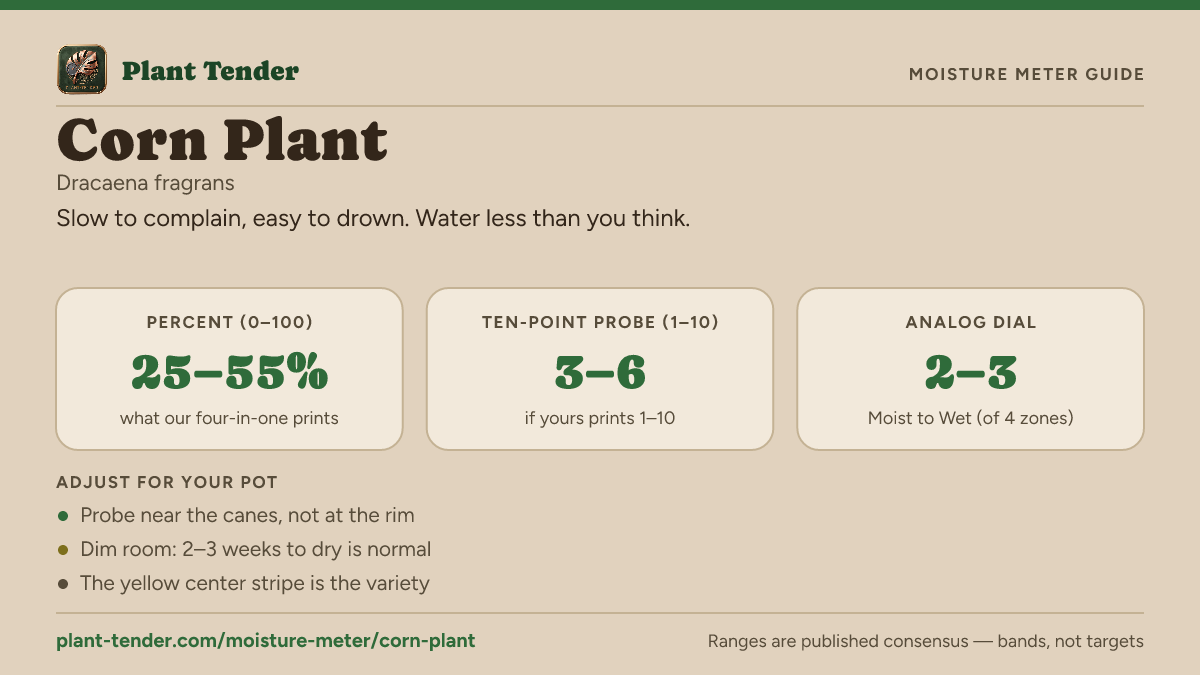
Percent (0–100)
25–55%
what the four-in-one we recommend prints
Ten-point probe (1–10)
3–6
if your probe prints a bare 1–10 sweep
Analog dial
2–3
Moist to Wet — of 4 zones
That is the band you are aiming for, not a target to hit exactly. These ranges are published horticultural consensus and are deliberately banded wide — these are unpowered galvanic probes, two of them in the same pot routinely disagree, and fertilizer salt raises the reading with no extra water present.
Got the plant in front of you? Point your camera at it — Plant Tender names what is in the pot from one photo and gives you the numbers it wants. No account, no card.
What each reading means for a corn plant
A corn plant wants water below 25% and starts staying wetter than it likes above 55%. If your probe prints a bare 1–10 sweep instead of a percentage, that works out like this.
| Reading | For this plant | What to do |
|---|---|---|
| 1 | Bone dry | Well past dry. Water thoroughly now — look for leaves drooping from the canes and feeling thin and soft rather than firm. |
| 2 | Thirsty | Dry enough to water. Water on the next check unless you watered in the last day or two. |
| 3 | In the healthy band | Inside the healthy band. Leave it — the useful question is whether this number is falling since last time. |
| 4 | In the healthy band | Inside the healthy band. Leave it — the useful question is whether this number is falling since last time. |
| 5 | In the healthy band | Inside the healthy band. Leave it — the useful question is whether this number is falling since last time. |
| 6 | Wetter than ideal | Wetter than ideal. Fine a day or two after watering; a concern if it has been a week. |
| 7 | Wetter than ideal | Wetter than ideal. Fine a day or two after watering; a concern if it has been a week. |
| 8 | Saturated | Saturated. If this has not fallen in several days, check drainage before you change anything else. |
| 9 | Saturated | Saturated. If this has not fallen in several days, check drainage before you change anything else. |
| 10 | Saturated | Saturated. If this has not fallen in several days, check drainage before you change anything else. |
Every row here is worked out from this plant's own numbers — a corn plant at 4 and a snake plant at 4 are in genuinely different situations.
The number depends on your soil, and most charts ignore that
A corn plant is usually in dense potting mix in a large pot, usually thick cut canes planted as a group.
Corn plants are usually sold as mass cane: thick, cut canes rooted in a large pot, with tufts of leaves sprouting near the top. The canes look substantial, but their roots often fill only part of that pot, so much of the soil has few roots in it and dries slowly. Add the dim corner corn plants so often end up in, where the plant drinks very little, and the pot can hold a mid-band reading for weeks. This is a plant that rarely complains, which is exactly why it gets watered out of habit.
Adjusting for your mix
Dense mix in a large pot, in low light: readings are honest but slow, two to three weeks between waterings is normal, and a shorter gap is usually too often. The same pot in a bright spot: the plant drinks faster and the range on this page applies at an ordinary pace. Perlite-amended mix: dries faster and reads slightly low. A decorative outer pot: check the bottom after watering, because a corn plant standing in an inch of water keeps the bottom of its pot wet indefinitely.
Plant Tender asks which of these your pot is in — dense potting soil, chunky aroid mix, bark / orchid mix, semi-hydro / pon, succulent / cactus grit — and applies the adjustment for you, along with a probe-depth target from your pot size.
Where to put the probe
Halfway down and within a few inches of the canes, not out at the rim. The roots stay close to the canes, so the soil near the pot wall has few roots in it and reads wetter than the root zone, especially in the oversized pots mass cane is sold in. Take the reading on the same side each time.
How a corn plant actually fails
Too much water, delivered patiently. A corn plant in low light can go weeks without needing a drink, and a weekly habit turns into a pot that never dries. The signs appear slowly: lower leaves yellow and droop, then brown, the soil may start to smell sour, and eventually the base of a cane goes soft. What is not a sign is the yellow or lime-green stripe down the middle of each leaf on the most common variety; that stripe is how the plant is supposed to look. Brown leaf tips on their own point to tap water rather than to how much you water.
Common situations
My corn plant is in a dark corner and reads 4 a week after watering.
Leave it. A 4 is inside the band, and in low light this plant can take two or three weeks to get down to the bottom of it. Wait until a reading taken near the canes drops to 2, and water then. If that works out to watering every three weeks, that is the right pace for that corner, even though it may feel like neglect.
The leaves have a yellow stripe down the middle — is it overwatered?
No. The stripe is the plant. The most common corn plant has a yellow or lime-green band down the center of each leaf, new leaves included, and it can fade in low light. Overwatering looks different: whole leaves yellowing from the bottom of the plant up, or from the tips inward, in a pot that reads 6 or higher and has not moved in a week or more.
It reads 6 and has not changed in three weeks.
That is the pattern to act on. A 6 is the very top of the range printed at the head of this page, and the table puts it in the wetter-than-ideal rows: past about 55% is more water than a corn plant wants. Three weeks without movement means the soil is not drying at all. Stop watering. Check that the pot has a drainage hole and is not standing in water inside a decorative pot. Then press the base of each cane: firm is good, while soft or hollow-feeling means rot has started. If the canes are firm, let the pot dry fully before the next watering, and consider a brighter spot, or a smaller pot at the next repot.
One reading can't be trusted. How fast the pot dries out can.
Everything above is really one argument: a single number from a cheap conductivity probe is not a measurement, it is a data point with a large error bar. Fertilizer salt raises it. Air gaps in chunky mix lower it. Probe depth moves it several points. Two meters in the same pot disagree.
What survives all of that is the trend. The same meter, in the same spot, in the same pot, read over a few weeks, tells you how fast your corn plant in this specific mix in this specific room actually dries — and that is the thing that answers "do I water it", which no chart can do for you.
Stop looking it up. Point your camera at your corn plant.
The bands above are for corn plant in general. Plant Tender gets there from a photo instead: one shot of what is actually in the pot, and it names the plant and gives you the soil-moisture, soil-temperature and light numbers that plant wants. Your first scan needs no account and no card.
Scan a plant — free, no accountAlready know what it is? Save it to Plant Tender and it remembers what your corn plant read last time, then tells you water or leave-it-be — so you are reading a trend instead of interpreting one number in isolation. Free for your first three plants.
Ranges come from Plant Tender's per-species dataset, which is version-controlled and reviewed in public — Dracaena fragrans, 25–55% moisture, 61–76°F soil temperature, low to medium indirect light.